RCA
Rotational Cooperative Auction
A dynamic framework for reading cooperative market auctions across multiple timeframes. My favorite framework, built on Game Theory, Auction Market Theory, and the observation that markets mostly rotate — up, down, or sideways — it is always a rotation.
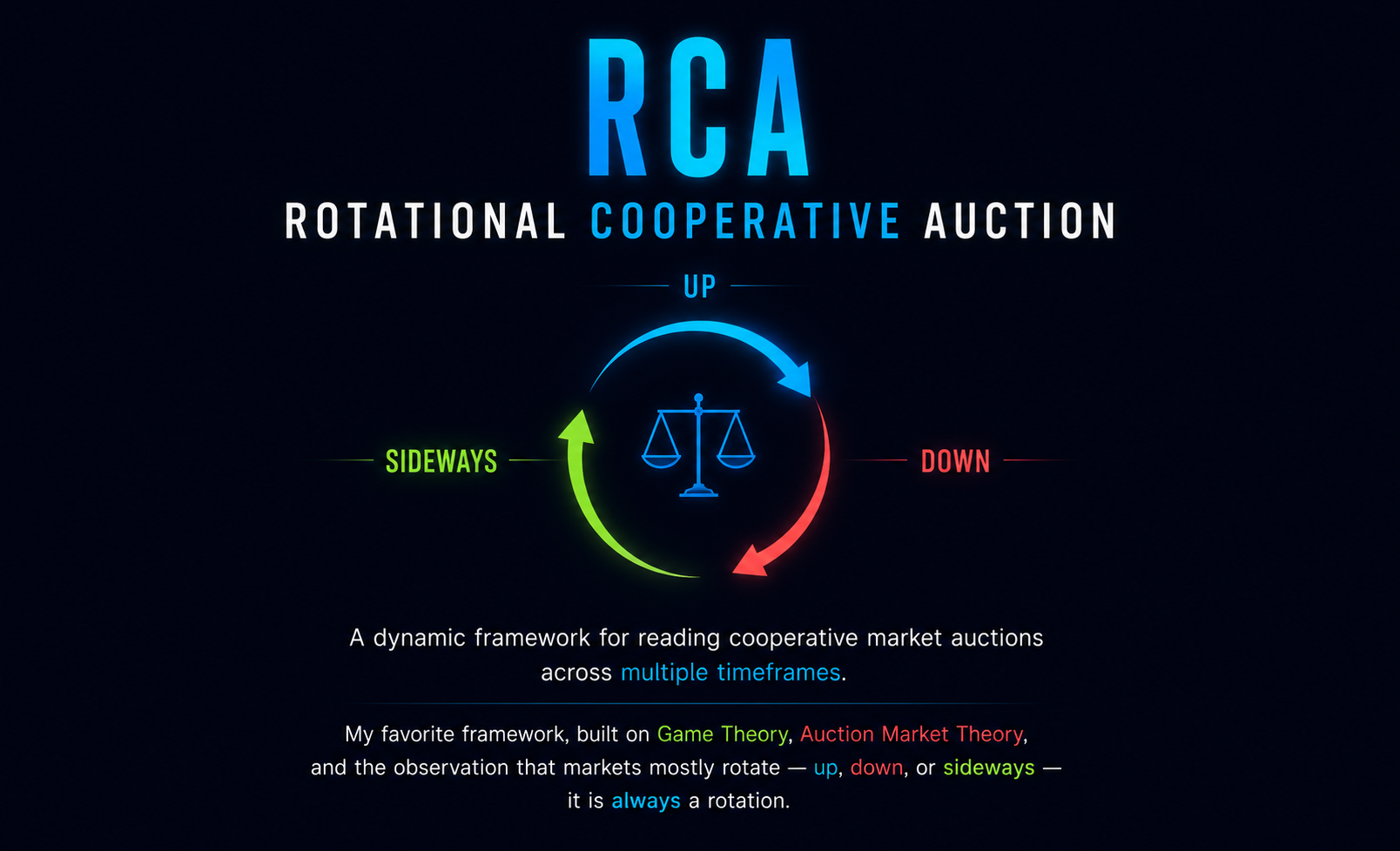
R— Rotational
I don't read markets as trending — I read them as constantly rotating. Price slowly nudges along while oscillating, testing new territory and rotating back through known prices. What looks like a trend is just a sequence of rotations. This rests on the 80/20 idea from Auction Market Theory — taken to the extreme: assume rotation within balance first, and treat true directional discovery as the rare exception.
C— Cooperative
This is the Game Theory side of the market. I bet on cooperation far more then on competition or manipulation. Markets are a hierarchy of differently-sized participants, and the biggest players usually win by cooperating with one another.
The large players cooperate to maximize their profits — and they punish participants who try to manipulate or take advantage of others. The framework is designed to position alongside that cooperation.
A— Auction
Everything happens inside one continuous auction expressing itself across multiple scales — relying on Auction Market Theory: Responsive vs Initiative participants, advertisment and acceptance vs rejection of values. There aren't separate monthly, weekly, and daily auctions; there is one auction, and its scales continuously cooperate and constrain one another.
Objective
Trade the interaction that is happening, not the prediction. Read how the cooperating auctions become clear or confusing — then position yourself in the wake of that cooperation among the large participants.
Rotational, Not Trending
This is the part of the framework that's new to how I read markets. I don't think in terms of trends. I think in terms of rotation.
The Elimination of Trend
There is basically an elimination of trend as a concept. Instead of a market that runs in a direction, I see one that is slowly rotating — nudging price along while constantly oscillating, testing new territories, and rotating back through known prices.
What looks like a "trend" is just a sequence of rotations, each one nudging value a little further as the cooperating auctions agree to move. Price is always probing: reaching into unknown territory to find liquidity, then rotating back through accepted value to confirm it.
Rotate Through Known Prices
Most of the time, price is revisiting prices it already knows — oscillating through accepted value, re-auctioning levels where participants already agreed to trade.
Test New Territories
Occasionally it nudges into the unknown — a probe to test whether new price is accepted. If it is, value rotates outward. If not, price rotates straight back.
80/20 — Taken to the Extreme
This rests on the classic 80/20 observation from Auction Market Theory: the market stays in balance roughly 80% of the time. RCA takes this even more extreme — treating almost everything as rotation within balance, and true one-directional discovery as the rare exception.
If you assume rotation first and trend almost never, you stop chasing breakouts and start trading the oscillation — fading extremes, expecting the return to known value, and only respecting a move once the auction genuinely accepts new territory.
The Market Is a Game
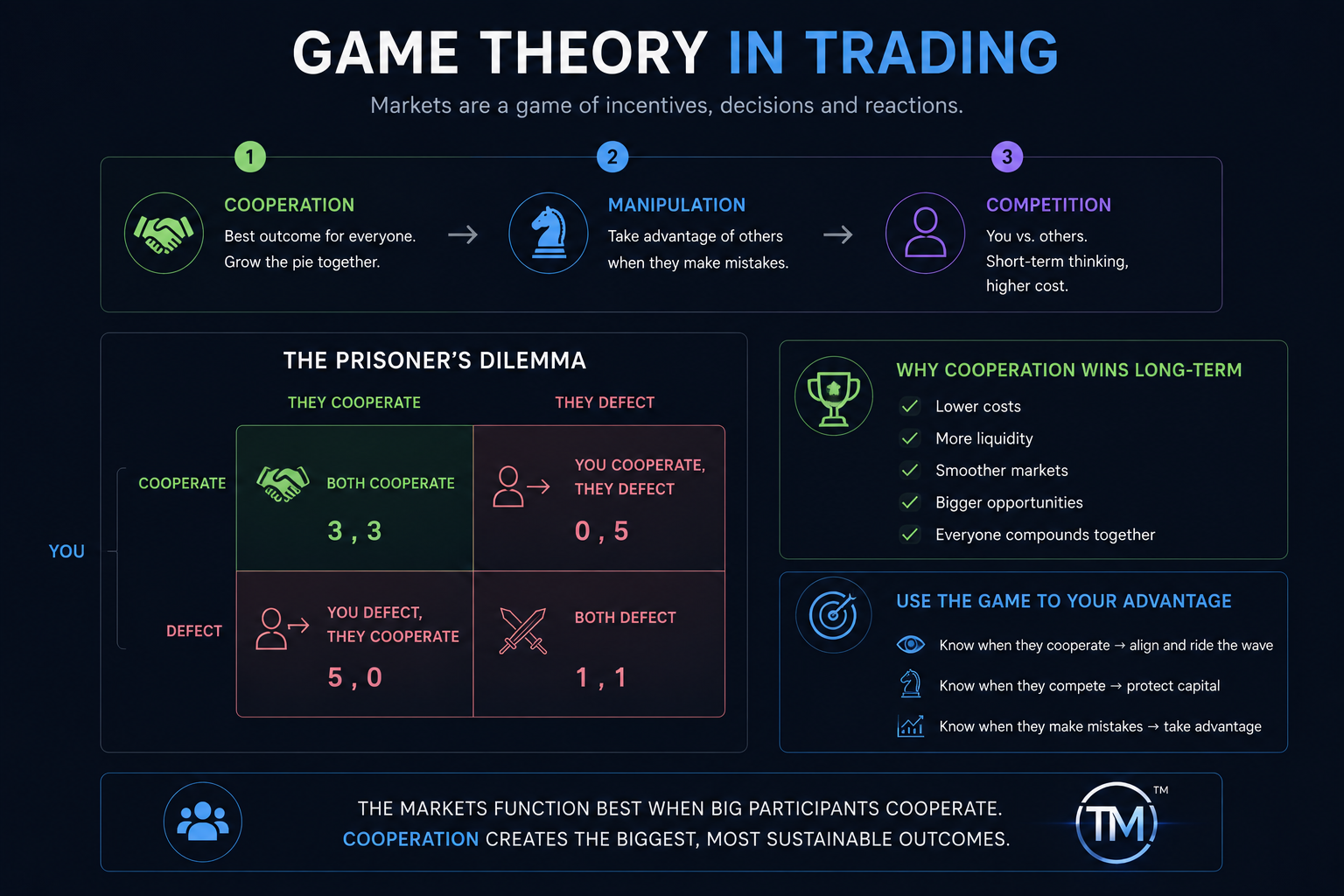
Markets are a game of incentives, decisions, and reactions. Every participant is simultaneously deciding whether to cooperate, compete, or exploit.
Three Modes of Play
1. Cooperation
Best outcome for everyone. Grow the pie together.
2. Manipulation
Sometimes the Larger Player takes advantage of the Medium Player if they make mistakes or try to outsmart others.
3. Competition
Large Titans compete & fight. In war, everyone loses or one wins at very big costs.
The Prisoner's Dilemma in Markets
The classic payoff matrix applies directly: when both sides cooperate (3,3), everyone benefits sustainably. When one defects while the other cooperates (5,0), the defector wins short-term but destroys trust. When both defect (1,1), everyone loses — high friction, thin liquidity, unpredictable moves.
Cooperation creates the biggest, most sustainable outcomes. This is why markets spend most of their time in balance — the big participants are cooperating, and everyone compounds together. Imbalance happens when someone defects.
Use the Game to Your Advantage
- → Know when they cooperate — align and ride the wave
- → Know when they compete — protect capital
- → Know when they make mistakes — take advantage
Big Fish, Small Fish
The market is an ecosystem. Size, timeframe, and influence form a hierarchy — and each tier plays a different role in the auction. I don't read multiple timeframes; I read differently-sized participants expressing themselves at different scales.
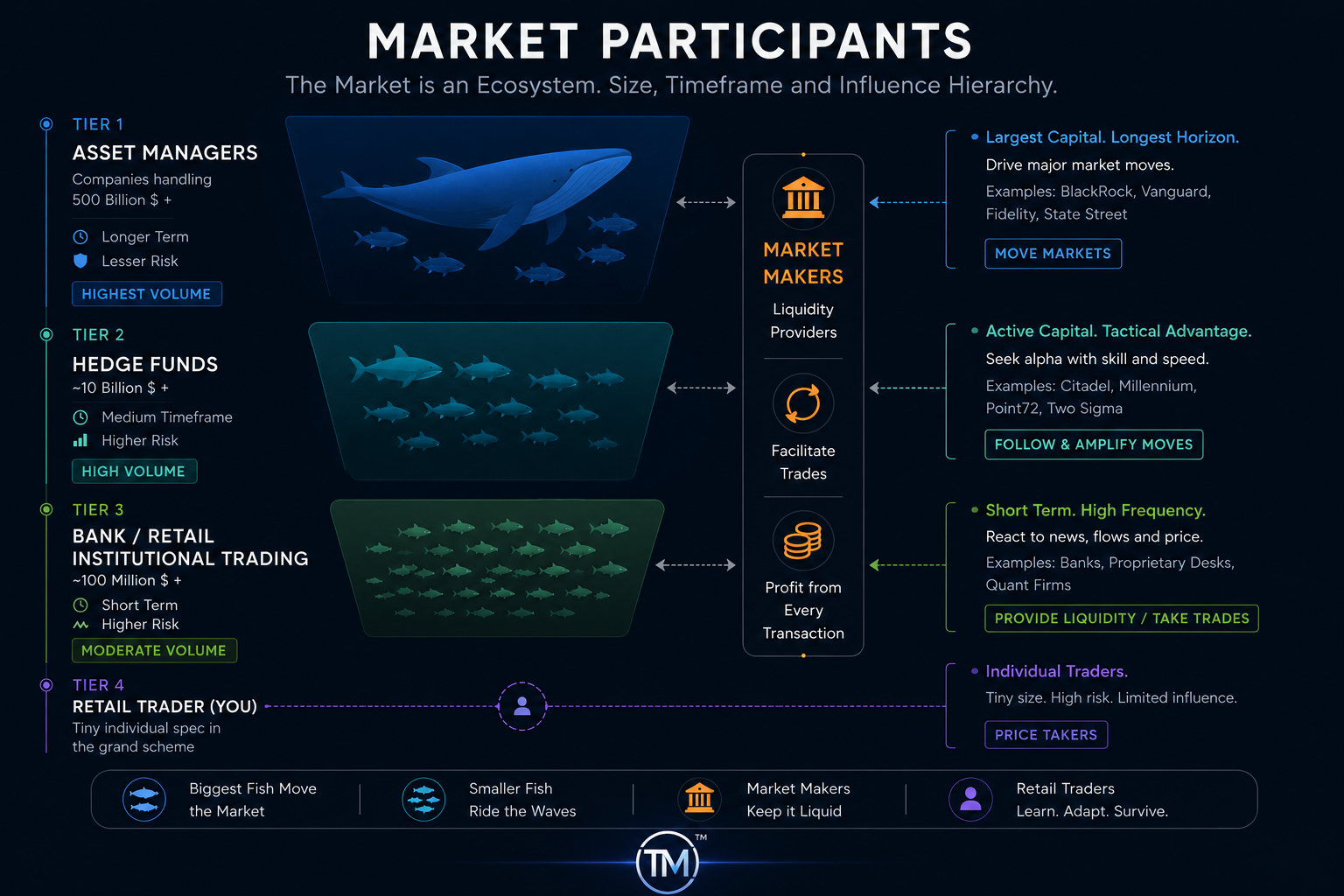
Tier 1 — Large Liquidity (Market Drivers / Strategic Impact)
Very large capital, global reach, longer horizon, lower relative risk. Sovereign funds, pension funds, large institutions. They drive the market. Their cooperation shapes the major trends and cycles.
Tier 2 — Medium Liquidity (Active Allocators / Alpha Seekers)
Substantial capital, regional focus, medium horizon, moderate risk. Prop firms, family offices, CTAs, regional funds. They follow and amplify the moves Tier 1 creates.
Tier 3 — Small Liquidity (Tactical Players / Opportunity Takers)
Focused capital, niche opportunities, shorter horizon, higher risk. Proprietary traders, quant strategies, active desks. They provide liquidity and take trades, capitalizing on short-term moves.
Tier 4 — Micro Participants (Individual Traders / Price Takers)
Limited capital, minimal market impact, very short horizon, highest risk. Day traders, retail traders. We don't move the market. Our edge is agility: observe, adapt, and position in the wake of the big participants.
Market Makers (Liquidity Providers)
Sit across all tiers facilitating flow. They keep the auction liquid, profit from transactions, and prefer balance because that is where volume lives. The ultimate responsive players.
Use the Participants to Your Advantage
- → Observe their methods and movements
- → Observe when they align — and join them. Surf with them.
- → Observe when they compete — step aside, protect capital
- → Observe when smaller liquidity makes mistakes — that's where the big fish feed and take advantage of smaller ones
Balance vs Imbalance
This is how Auction Market Theory sees it: markets exist in only two states — Balance (Range) and Imbalance (Trend).
I keep that lens, but I choose to read it differently. I see large angled rotations — the creation of new auctions and the revisiting of old auctions. What AMT calls imbalance, I read as a rotation probing for a new auction. What AMT calls balance, I read as a rotation returning through a known auction. Everything else is detail inside that rotation.
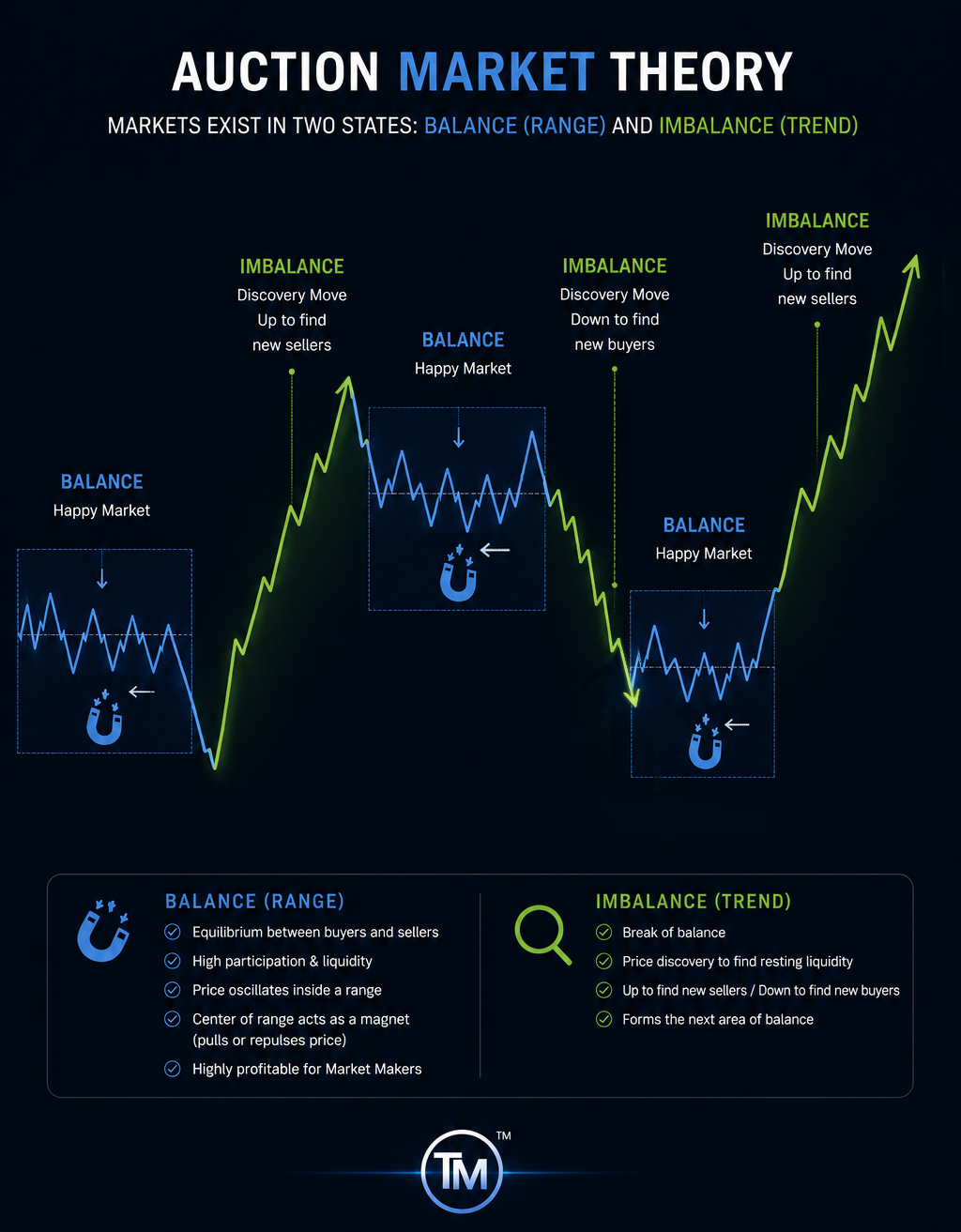
Balance (Range)
- → Equilibrium between buyers and sellers
- → High participation & liquidity
- → Price oscillates inside a range
- → Center of range acts as a magnet (pulls or repulses price)
- → Highly profitable for Market Makers
Imbalance (Trend)
- → Break of balance
- → Price discovery to find resting liquidity
- → Up to find new sellers / Down to find new buyers
- → Forms the next area of balance
The Cycle
The market constantly cycles between these two states: Balance → Imbalance → New Balance. Balance is the "happy market" — where participants agree on value and volume is high. Imbalance is the discovery move — where one side overwhelms the other and price searches for new levels where two-sided trade can resume.
This cycle repeats at every timeframe, fractal in nature. The same pattern on a 5-minute chart plays out on a daily chart — just different participants and different time horizons.
Why This Matters
Every trading decision reduces to one question: Is the market in balance, or breaking into imbalance? In balance — fade the edges or wait. In imbalance — join the discovery move and surf with the big fish.
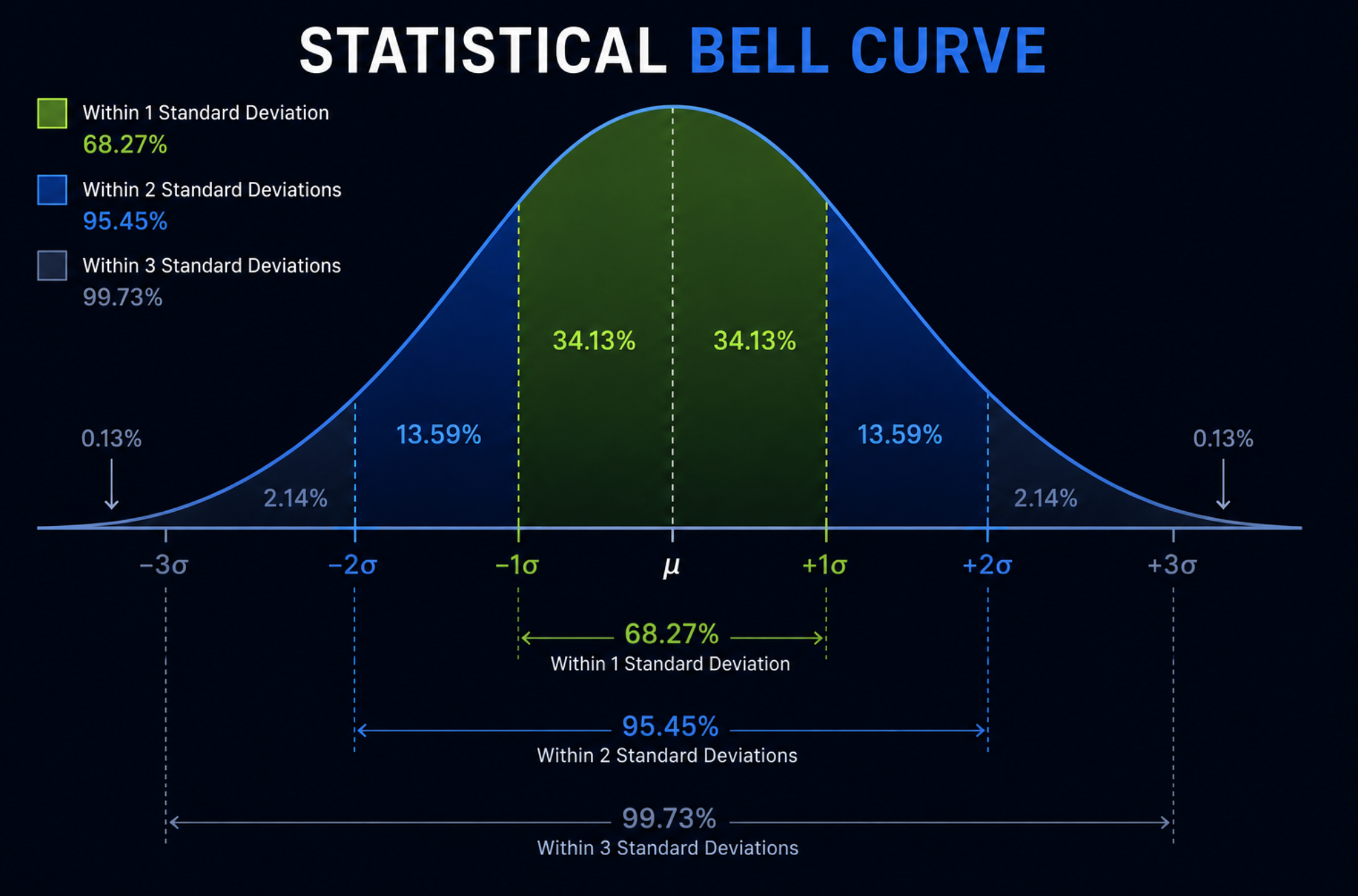
The Bell Curve
Balance creates a bell curve of volume. The fat middle is where most transactions happen — and that's the value area the market has accepted as fair.
The Crowd Behavior Behind the Curve
Auction markets, like any human endeavor, follow the bell curve. Most of the time, crowds return to what they know — the mean, the average, the comfortable price. This is behavioral, not mathematical: humans are creatures of habit, and traders are no exception.
When price explores new territory, the crowd hesitates. When price returns to familiar levels, the crowd participates. The mean — the most traded price — becomes the anchor. Everything else is deviation.
The market profile visualizes this: the POC is where the crowd feels safest. The value area is where they're willing to transact. Beyond the value area, the crowd thins out — prices become exploratory, not accepted.
Probability on the Price Axis
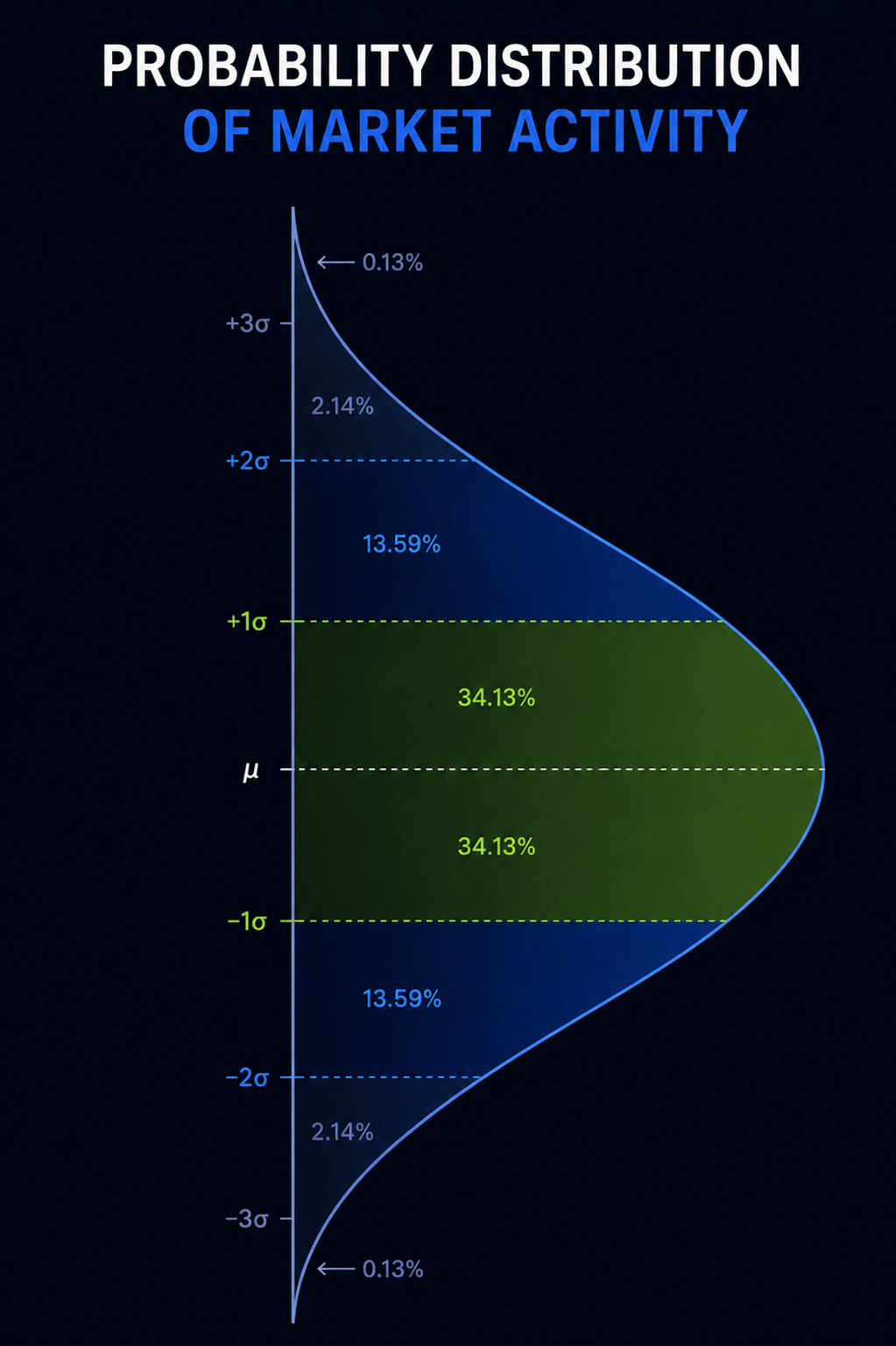
Rotate the bell curve 90 degrees and overlay it on price. Now the distribution shows where trading activity concentrates — not when, but at what price levels.
In trading tools, we aggregate this from volume data. Each contract traded is market activity. As we aggregate where that activity happens at specific price levels, these behavioral statistics emerge — creating a clearer picture of market participants than what a price chart alone can provide.
The thick middle is where the crowd feels comfortable. These prices are common — visited often, traded heavily, accepted as fair. The thin tails are rare — extreme prices where few participants engage. When price reaches these outer zones, it either finds responsive players pulling it back, or initiative force breaking through into discovery.
This is the statistical reality behind the auction: some prices are habitual, others are exploratory. Know which zone you're in.
Market Makers Love Balance
Every time price oscillates in a range, market makers collect the spread on both sides. More rotations = more transactions = more profit. They have every incentive to keep price contained. They provide liquidity at the extremes (VAH/VAL).
Institutions Accumulate in Balance
Large players need range to fill their positions without moving price against themselves. Balance is where they build. The longer balance lasts, the bigger the position they're building — and the bigger the eventual move.
The Implication
The bell curve tells me where fair value is right now. When price is within the value area, the market is happy — balance. When price breaks outside the value area with conviction, that's the discovery move — imbalance. The old value area becomes a reference: will it act as support/resistance, or will price slice through?
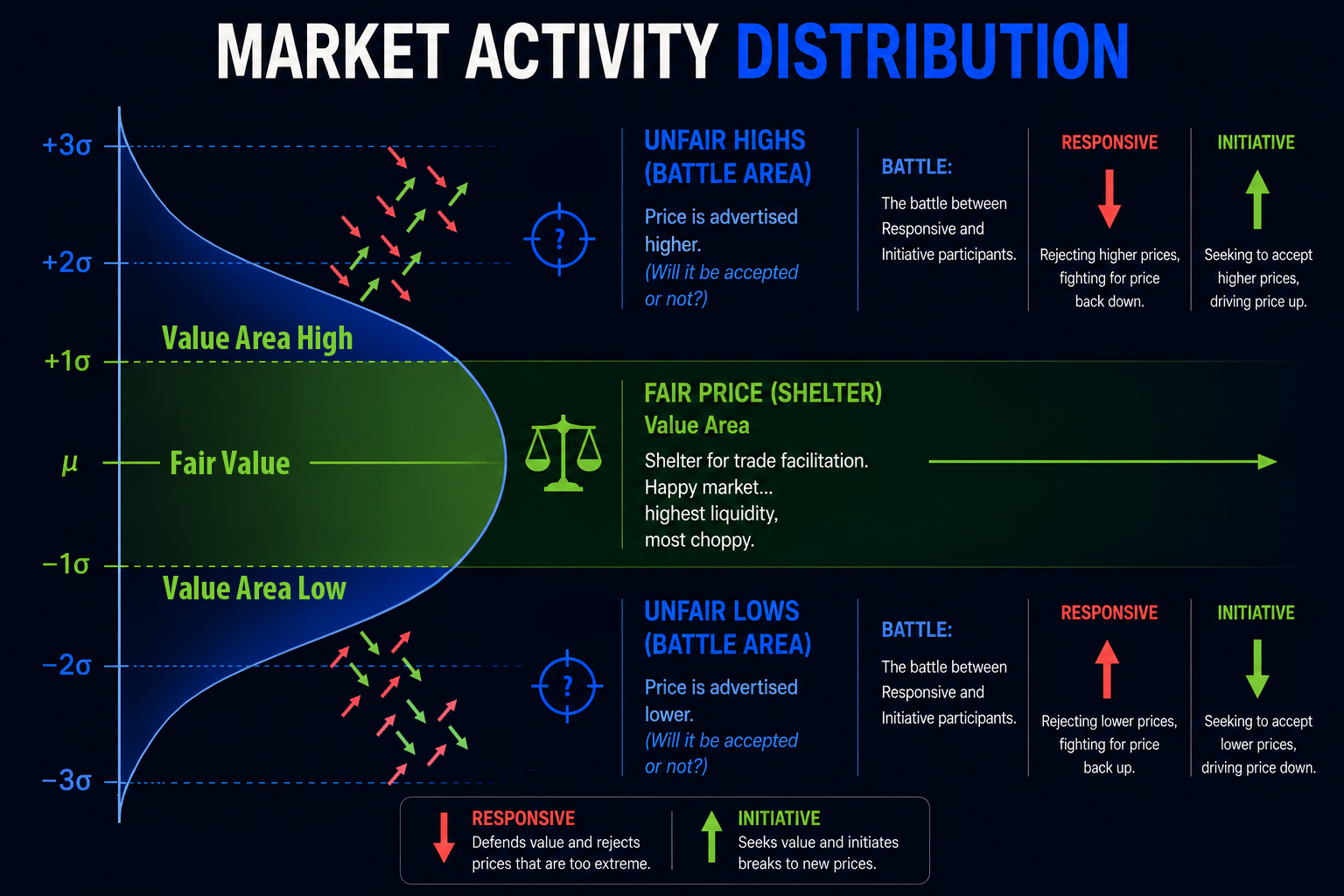
Responsive vs Initiative
Two forces battle at the edges of value. The only questions that matter:
The Read
Where is the battle? Beyond the value area edges — VAH and VAL. This is where responsive players defend the Fair Price and initiative players attack.
Is price accepting? Instead of obsessing over who is fighting, I pay attention to whether price is being accepted in that area. Is price spending time there and trading heavily? That means acceptance, and acceptance confirms direction. On the other hand, if the area is rejected and price quickly moves away, that confirms the opposite path. That's the entire read necessary.
📖 To Be Continued
This section will be expanded with practical examples of reading responsive vs initiative activity in real market conditions, confirmation signals, and entry frameworks.
Trade the Interaction, Not the Prediction
The whole point of RCA is to stop forecasting and start reading the interaction between cooperating auctions — then position in the wake of that cooperation.
The Aha
Instead of thinking in terms of multiple timeframes, think in terms of differently-sized market participants expressing themselves at different scales.
There aren't five separate auctions (monthly, weekly, daily, intraday...). There is one continuous auction expressing itself across multiple scales — and those scales continuously cooperate and constrain one another.
What This Changes
- → Stop predicting direction — read whether the scales are cooperating
- → Assume rotation within balance first; respect discovery only once accepted
- → Position alongside the large cooperators — surf, don't fight
⚠️ Disclaimer
This content is for educational and informational purposes only and does not constitute financial advice, investment advice, trading advice, or any other sort of advice. The information presented here is general in nature and is not specific to you, the user.
Trading and investing in financial markets involves substantial risk of loss and is not suitable for every investor. Past performance is not indicative of future results. You should carefully consider your investment objectives, level of experience, and risk appetite before making any trading decisions.
You are solely responsible for your own trading decisions. The author is not a licensed financial advisor, broker, or dealer. Never risk more than you can afford to lose.